
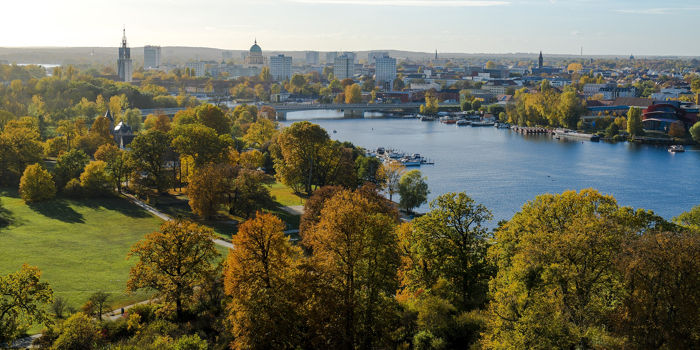
The city, which is over 1,000 years old, is widely known for its palaces, its lakes, and its overall historical and cultural significance. Landmarks include the parks and palaces of Sanssouci, Germany's largest World Heritage Site, as well as other palaces such as the Orangery Palace, the New Palace, Cecilienhof Palace, and Charlottenhof Palace. Potsdam was also the location of the significant Potsdam Conference in 1945, the conference where the three heads of government of the USSR, the US, and the UK decided on the division of Germany following its surrender, a conference which defined Germany's history for the following 45 years.
Babelsberg, in the south-eastern part of Potsdam, was already by the 1930s the home of a major film production studio and it has enjoyed success as an important center of European film production since the fall of the Berlin Wall. The Filmstudio Babelsberg, founded in 1912, is the oldest large-scale film studio in the world.[4]
Potsdam developed into a centre of science in Germany in the 19th century. Today, there are three public colleges, the University of Potsdam, and more than 30 research institutes in the city.